Showing posts with label pasir ris. Show all posts

Tuesday, May 15, 2012

Mynah - Pasir Ris

We were waiting for the public transport (bus) to arrive & chanced upon this chubby looking mynah whose busy picking up twigs to build up its nest.

"She" was probabbly so engrossed in scavenging for raw materials that it didn't realise that she's on candid camera ...


Isn't she cute looking?  hahahaha ...

Saturday, May 12, 2012

Community Cats (Pasir Ris)

We were strolling towards Sakya Tenpheling located at Pasir Ris Drive 4 when we came across these 2 community cats napping at the void deck of flats.

They are definitely at perfect ease in their home environment to be sleeping in such a fashion with their tummies exposed!

Aren't they adorable?


This ginger-coated cat ignored us as we went on meowing to get its attention.  It's busy sleeping & didn't want to be disturbed ...


This black tuxedo-ed cat simply turned around to stare at us sheepishly & turned back towards the wall to continue sleeping ...

Thursday, May 10, 2012

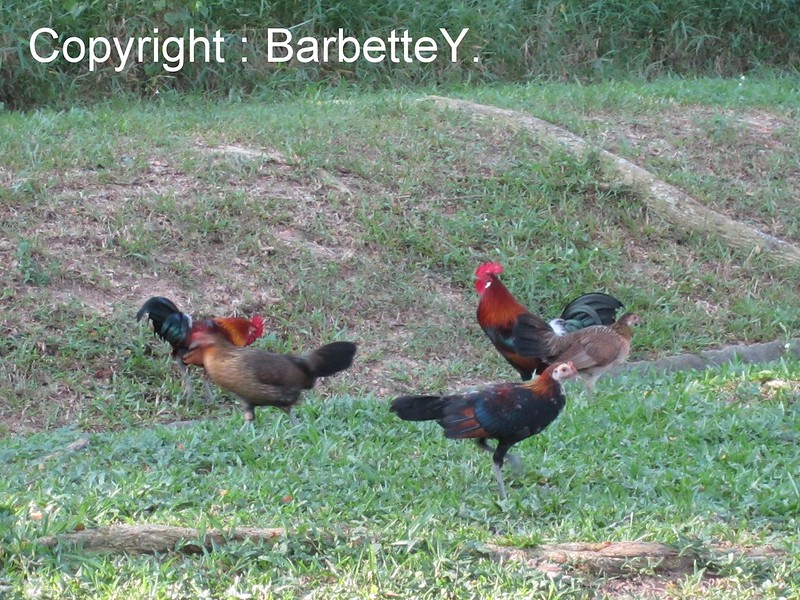
Chickens & Roosters

We were surprised when we saw roosters & chickens roaming freely at Pasir Ris Park. Some had attempted to "fly" but it was more like a high jump.


Posted Image

Posted Image

Creatures from the swamp

 didn't mean the famous Swampthing shown on TV during childhood when I refer to creatures from the swamp. The creatures are the habitants found in the swampy region of the Pasir Ris Park.

The photograph below shows a mudskipper :
Posted Image

The rest of the 4 consecutive photographs features crabs, ranging from huge ones to smaller versions. They were taken with our digital camera's zoom-in function :

Posted Image

Posted Image

Posted Image

Posted Image

Ulam Raja / Pelampong (Scientific Name : Cosmos caudatus Kunth)

When we visited the Pasir Ris Park recently, we spotted another breed of cosmos flower growing amongst the Orange Cosmos.

This version of the Cosmos flower is in ombre pink (meaning that there's is a graduation of white to pink on its petals).
Posted Image

Not unlike its orange counterpart, the pink cosmos flower attracts both butterflies & bees as shown in the photograph below:
Posted Image

Based on National Park's Flora & Fuana Web, this breed of flower's scientific name is known as the Cosmos caudatus Kunth.

It is also commonly known as Ulam Raja or Pelampong and its leaves were known to be of medicinal value e.g. it is used to increase blood circulation in traditional medicine in the South East Asia.

Its leaves were also consumed as a vegetable in Malay cuisine.

Golden Trumpet Flowering Climber (Scientific Name : Allamanda cathartica)

This is a flower that is pretty commonly found in nurseries and even at some public places.

Posted Image

Posted Image

HIBISCUS (Different breeds)

Hibiscus flowers are a common sight found in the private gardens of homes & nurseries all year round.

I've tried my luck on Hibiscus but they were tough on me & would usually die off as they require alot of sunlight. The nurseries had also advised me that Hibiscus plants are prone to diseases and not advisable for homes that do not receive much sunlight.
(Rule of thumb: Flowering plants require adequate sunlight to survive & bloom)


The Hawaiian Salmon
As I couldn't find the breed of this Hibiscus flowering plant from the National Park's website, I've looked elsewhere & found that it's known as the Hawaiian Salmon.

Posted Image

Posted Image

The colour of such breeds of Hibiscus does look like the meat of cooked salmon. They are characterised by hanging multi-coloured flowers & are fast growing. According to sources, they are good for outdoors.

Posted Image


Hibiscus schizopetalus

To start with, we didn't know that this was also a breed of Hibiscus because the flowers looked nothing like the typical Hibiscus.

Posted Image

The Schizopetalus Hibiscus was said to be a weeping tree hibiscus. Its flowers are characterised by a parachute-like appearance and can be identified by the dangling stamen and lacy petals. It does look like a pretty, red chinese lantern, which explains why it is also commonly known as the Chinese Lantern / Japanese Lantern.

A less desirable nickname is the Skeleton Hibiscus.

Don't you think that these flowers look like pretty chinese lanterns with tassels & dangling from the branches?
Posted Image

When we first spotted the plant at Pasir Ris Park, it looked quite pathetic although there were plenty of freshly bloomed flowers. Its stature resembled nothing like what we have seen in the photograph attached below. The photograph's version of the Hibiscus looked really healthy with good growth of green leaves.

Posted Image

The version in Pasir Ris Park looked neglected & quite "bare", to the extent that there were only 3 to 4 stalks of leaves on the stem even though there were 5 hibiscus flowers growing from it.
The buds of these blooms resembled smooth-skinned peanuts as shown in the photograph below:
Posted Image

More photographs of the red lanterns
Posted Image

Posted Image 
The Chinese lantern being flanked by another breed of Hibiscus:
Posted Image

Honolulu Creeper (Scientific Name : Antigonon leptopus)

I think most of us would find this creeper a very common sight especially decades ago when Singapore isn't as urbanised as these modern times.

I used to recall that many old houses in the past were surrounded by green or even rusty wire mesh-like fencing & they would be flanked by Honolulu Creepers or Blue-bell plants.

These Honolulu Creepers had a lengthy list of commonly-known-as names, such as the Chinese Love Vines, Chain of Love, Hearts on a Chain, Queen's Wreath. Which speaks alot on love & romance... :wub:

Posted Image

Since the Honolulu Creeper is so closely associated with love & romance, and has such a saturated tone of fuchsia pink, then it must be an auspicious flower to be grown in parks & perhaps, the Registry of Marriage could consider having such creepers planted within its vicinity too!

I've incidentally fished out its chinese name from National Park's website, which says: 珊瑚藤 or 朝日藤.

I love the saturated shades of pink! Don't they look yummy?

Posted Image

Posted Image

Floral series : Orange Cosmos (Scientific Name : Cosmos Sulphureus)

We noticed that butterflies love them and the shrubs of these orange blossoms were found to be clustered in Pasir Ris Park.

And these orange, cheery-looking flowers had definitely added alot more vibrance to the palette of colours in any garden.

Posted Image

This photograph shows the yellow version of the flower, which is not as abundant in bloom as compared to its orange counterparts:
Posted Image

Photographs of its shrub with pretty orange blooms (with a few yellow versions):
Posted Image

Posted Image

A weather-beaten shrub after a heavy downpour that took place throughout the day:
Posted Image

Applying "softening" editing effects on this photograph to achieve a dreamy effect:
Posted Image

Floral series : Madagascar Periwinkle (Scientific Name : Catharanthus roseus)

Periwinkle flowers are not my favourite. I used to see them all over along the streets during my childhood. In my opinion, I always had the impression that they are "weeds" ...

Posted Image

Floral series : Seven Golden Candlesticks (Scientific Name : Cassia Alata)

After loitering into the premises of the nursery @ Pasir Ris Park, I was pleasantly surprised & elated when I spotted an abundance of this marvelous breed of medicinal plant known as the Seven Golden Candlesticks.

Its scientific name is Cassia Alata. And because its medicinal uses are varied across cultures, it is also commonly known as the Candle Bush, Gelenggang in Malay or Akapulko in Philippines.

I've been nicknaming this plant "Iron-Fan princess" because the shape of its leaves resembled that of the Iron-Fan pricess' magical Iron Fan in the chinese folklore of fairies known as Journey to the West where the mischievous Monkey King dealt with devils & evil spirits who were hankering after the flesh of his guru, Tripitaka.

Posted Image

As the plant produces alot of nectar, it attracts many huge red ants who were eager to get a share of food.

For the plant to survive, it requires plenty of sunlight to flourish. The photograph below shows a picture of a spray of flower that stands tall on the top of its plant.

Posted Image

For more information about the plant, please visit the following website:
http://www.naturia.per.sg/buloh/plants/candlesticks.htm
Please allow me to share my experience with this plant. I had a strong & long-standing affinity with this plant as far back as in the 1980s. As a child, my skin had been frequently plagued with problematic skin. My feet would break out in blistered-like rashes & itch throughout the day. The skin on my feet didn't just break out in sores during childhood but the skin started peeling to the extent that it became scaly.

Dermatologists were consulted but the condition couldn't be cured. In fact, the condition was making its way upwards from my foot soles all the way up to my ankles. To sum it up, my feet was not only gruesome looking but it was rotting with a bad stench!

It was during a fateful trips to one of the dermoatologists in a private hospital where the adults in the family chanced upon an old aunty whose also a patient. She told my parents to visit her bungalow as she had a plant that could cure my skin condition.

As we were all driven out of desperation, we accepted our invitation & drove up to her place. That was the very first time when we got to know all about this miraculous plant known as the Seven Golden Candlesticks.

Method:
The old aunty cut down about 5 stalks of leaves from her plant & my grandma rinsed them in water prior to boiling them in a metal pot of water. Once the leaves were boiled & cooked, you will notice that the "soup" is a shade of green.

The "soup" is then transferred into a huge aluminium of enamel-coated basin. While the liquid is still hot after boiling, I would force my feet into the basin & I assure you that this procedure should be done at every user's discretion. My threshold for heat is pretty high. Needless to say, it still hurts a big deal!

However, I must say that the "soup" of this Seven Golden Candlesticks works best when it is still hot (not lukewarm) because the hot temperature seemed to have a catalytic effect on curing the stubborn skin condition for my feet.

When my condition was extremely bad in the beginning, there was a stinging sensation during the feet soak. It hurt so badly that it felt like there were thousands of ants biting into those freakish rashes.

The colour of the "soup" gradually changed from a greenish shade to brown! This feet soaking ritual went on everyday for a period of 6 months before all the rashes were completely gone.

And I continued with the feet soak for another 6 months because all in the family were fearful that the skin condition might just relapse.

The results were remarkable becox not only did the skin on my feet heel, the skin texture looks good too!

This is a humble photograph of the current condition of my feet after a painstaking effort of adopting an intense feet soak using the "soup" of 7 Golden Candlesticks & I am extremely grateful to the old aunty who recommended us this plant & shared with us the remedy. God bless her for her kindness!
Posted Image

So for those of you out there who are lucky enough to own a home garden outside your landed property, I would highly recommend that you groom such a plant - but of course, you've got to be mentally prepared for a huge battle with those giant red ants!

Here's a photograph of a giant red ant getting itself transferred from the plant to the wooden shade nearby :
Posted Image

Butterflies

It has been said that a butterfly garden would be created at the Pasir Ris Park, where some of the prettiest blooms would be cultivated. This would attract many butterflies and become a hot spot for photographers who love taking snapshots of butterflies in action.

We've managed to take photographs of butterflies using our mini digital camera. It was definitely tough becox we've got to be really careful & hush-hush about moving around them as they might jux get skittish & fly off before we manage to capture those beautiful & colourful moments.

Although our digi-cam's resolution isn't as sharp but those butterflies still looks colourful & reasonably clear in the photographs as attached below:

Posted Image

Posted Image

Posted Image

Posted Image

Posted Image

Posted Image

Posted Image
 
Posted Image

Posted Image

Posted Image