Showing posts with label birds. Show all posts

Tuesday, May 15, 2012

Mynah - Pasir Ris

We were waiting for the public transport (bus) to arrive & chanced upon this chubby looking mynah whose busy picking up twigs to build up its nest.

"She" was probabbly so engrossed in scavenging for raw materials that it didn't realise that she's on candid camera ...


Isn't she cute looking?  hahahaha ...

Thursday, May 10, 2012

Is this Shama??

We're not sure if this bird is known as Shama, which is commonly found during singing bird competitions.

Posted Image

Posted Image

Woodpecker

We were surprised to see an Olive-backed woodpecker high up on one of the trees, working hard on the huge sturdy stem. I reckon that the tree must be grateful to the woodpecker for eating up worms & parasites residing on it...

Posted Image

My version of a photograph looked really blurry. As such, I've attached a professionally taken photograph of the woodpecker by Mr Paul Huang:
Posted Image

There are many breeds of woodpecker. For those of you who are curious as to how some of the other breeds in the family looked like, kindly visit Mr Paul Huang's website at http://www.naturestops.com/. Click on the "Birds" & type in "woodpecker" in the search engine.

Zebra Doves

Zebra Doves are my hubby's favourites & he claimed that it is very popular among bird breeders as they fetch alot of money.

We have taken some photographs of zebra doves which had been spotted by us at Pasir Ris Park.   

I'm sorry about repetitive shots of zebra doves in different positions. Since I didn't know which one to delete, I'll just retain them all in this blogging thread.

Posted Image

Posted Image


Posted Image

Posted Image

Posted Image

Posted Image


We spied on this particular zebra dove & see what it's been up to...
Posted Image

Posted Image

These zebra doves looked pretty well-fed even though they were living in the wild. We sincerely hope that things could be kept that way as we are praying that they wouldn't be caught by bird breeders who might just sell them for money or even lock them up in cages.

Spotted Doves

While we were walking home from Pasir Ris Park, we spotted a pair of Spotted Doves (Scientific name: Streptopelia chinensis / 珠颈斑鸠) perching on the fence (of a wafer fab factory).

My hubby whose a bird lover couldn't resist the temptation to capture a few photographs of them & I've captioned these photographs to (hopefully) make them more interesting...

Posted Image

Posted Image

Posted Image

For more information & details about Spotted Doves, please visit the following link:
http://swapsungeibuloh.wikispaces.com/Spotted+Dove

Oriental Pied Hornbill / Anthracoceros albirostris / 冠斑犀鸟

BIRDS:The Oriental Pied Hornbill
We were surprised when an Oriental Pied Hornbill (Scientific name: Anthracoceros albirostris / 冠斑犀鸟) came into view! The photograph doesn't have the ideal resolution as we were pretty eager to capture it before it discovered our presence.

Posted Image


It was a shy creature which was at perfect ease until we crept closer towards the tree it was perching at. The hornbill got abit wary & this could be illustrated in the next 2 photographs.

Posted Image

Posted Image

For more information & details about the birds of Singapore, please visit swapsungeibuloh blog at the following link:
http://swapsungeibuloh.wikispaces.com/Oriental+Pied+Hornbill

I assure you that the nature lovers wouldn't be disappointed after visiting the comprehensive website! In fact, both my hubby & myself had been very happy & thankful with the creators of the website as it was almost an encyclopedia of the birds of Singapore. The amount of work involved in creating such a website was gargantuan!

And here is a professionally taken photograph of a cute-looking (male) Oriental Pied Hornbill by Mr Paul Huang:
Posted Image

Disclaimer: Please note that I do not own any of the photographs of the Oriental Pied Hornbill featured here in this thread. As such, please give the credits of the photograph to the Mr Paul Huang of http://www.naturestops.com.

I also wish to take this opportunity to thank Mr Paul Huang of http://www.naturestops.com for granting his kind permission in allowing me to use his beautiful photographs in this forum.

It had certainly made an eye-opening difference to a nature lover like myself! 

Postscript:  However, my photographs stood out like a sore thumb as compared to his professionally taken photographs. Mine looks simply... amateurish.

The Sound Of Music: Nature's Beauty @ Pasir Ris Park (Brief Introduction)

After Hubby Dearest brought me for a long-distance jog into Pasir Ris Park, it was tough to ignore the beauty of mother nature in there.

So, I have decided to do a write-up of plants, lived-in insects and animals found at the Pasir Ris Park.

As usual, please enjoy the photographs which had been taken painstakingly by both Hubby Dearest & myself.

We didn't have any issues with the plants becox they don't move around.  However, the real challenge came with the insects & animals as they don't stop fidgeting & some flew off at the slightest movement or noise coming from their surroundings.

We hope that readers for this topic would enjoy the photographs as much as we did as the owners of these photographs. :)

I was surprised to see how a boat had been used to create a pond & took a snapshot of the boat. Oops, the 2 stalks of withered papaya leaves are showing up in the photographs like sore-thumbs! Forgot to remove them before photographing.

Posted Image
 
Please stay tuned for more photographs of the inhabitants of Pasir Ris Park & we promise nature lovers that you wouldn't be disappointed in the outcome! :)

Sunday, April 22, 2012

The Olive-backed Sunbirds' feast

There was a great feast for those olive-backed sunbirds today.

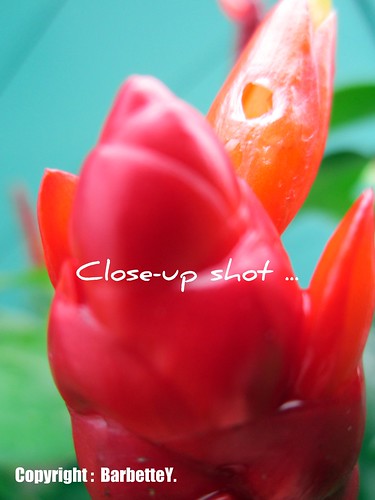
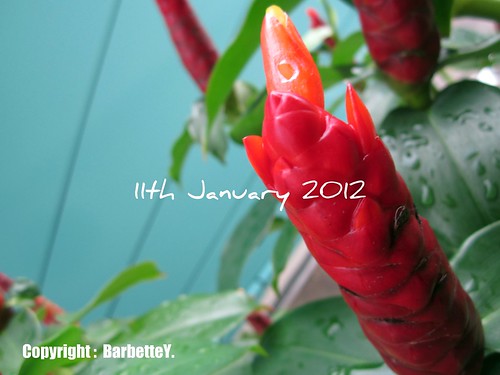
A hole which is clearly seen on every flower is a clear indication that the sunbird/s had already extracted the nectar. I believe they did it by "drilling" (piercing) a hole into the bud with their long sharp, needle-like beak.
Posted Image

After a heavy downpour yesterday, we were surprised that the "Ginger" plants were blooming vigorously. And as usual, we didn't manage to take any snapshots of the birds becox they would fly off the minute they sense any movements near the plants.

Even though the photographs of our "ginger" plants were repetitive in style, we hope that viewers would enjoy them as much as we do.

Posted Image

Posted Image

Posted Image

Posted Image

Posted Image

Posted Image

Posted Image 
Posted Image

Posted Image

Thursday, January 12, 2012

Sneaky visits by olive-backed sunbirds

The latest news about our regular visitor, the olive-backed sunbird, is that it has gone mute as it came without chirping at all.

Initially, when I spotted these holes on all my flower buds, I thought that the plants were infested with worms. And there was further confusion as my plant was also concurrently undergoing the after-effects of over-fertilising.

However, before I barge into the nursery to consult the Aunty who coached me in gardening, I caught the olive-backed sunbird red-handed.

Well, it didn't commit the "crimes" with any hands since they weren't part of its anatomy.

We discovered that instead of sticking its long, pin-like beak into the opening at the top of flower buds, it was a really lazy bird. Our friend use its pin-like beak to prick the flower buds & finally drilled a huge hole into the buds mid-way to suck out the flower nectar.

Posted Image

As such, there were many pin--like holes & 1 huge gaping hole on all the flowers buds.

If you asked me if it looked awful, yes it does affect the appearance of the poor plants.

After we made such a discovery by the naughty bird, we no longer based its presence on its chirping since it's been quiet nowadays.

Instead, the freshly bloomed buds which were marked with such holes were a very clear indication that the silly bird has already visited & drank its fill of flower nectar.


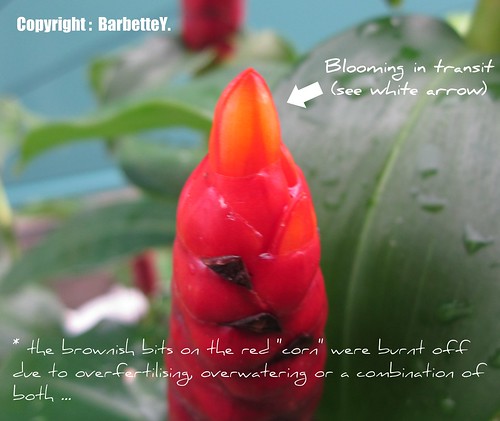
Did you see the flower (which had already been "attacked" by the bird) being flanked by 2 other flower buds which are going to bloom at any point in time?


I thought that this was really cute as the flower bud had been pushed out right at the top of the red "corn".

It's quite a pity that the red "corn" was burnt off earlier in view of overfertilising & also, over watering. Before the flower buds were being pushed out of the red "scales", it had already started rotting. After the unbloomed buds rot & die off, they would simply turn brown & dry up like how it's featured in the above photograph.

Saturday, October 1, 2011

The Story Of My "tree" Musketeers - Birdies : Companionship to Ginger plants & their flower buds ...
And not forgetting the birds, there is this particular species of bird that is small-bodied but greets these plants every single day without fail with a "he-he-he-he" sharp chirping voice.

They are known as Olive-backed Sunbirds (scientific name: Nectarinia jugularis) / 黄腹花蜜鸟.
copyright Paul Huang, http://www.naturestops.com)

For more information & details about the bird, kindly visit the following website:
http://swapsungeibuloh.wikispaces.com/Olive-backed+Sunbird

This video clip features a female Olive-backed sunbird returning to her nest after a hard day of flying around. However, it's a pity that the bird in the clip doesn't call out at all. Isn't the birdie cute when she peeps out from her nest?

It is cloaked in greenish & yellowy feathers; characterised by a long, sharp & needled-like beak which is abit bent downwards. Presumably for extracting nectar from the flowers blooming on this breed of Ginger plant.

When we had been greeted by a succession of loud, and cheery chirping, we knew for sure that the plants were blooming wtih an abundance of flower food for the birds. If those chirpy darlings greeted us with a short flat tone, we would be immediately aware that they were disappointed that they've got to look elsewhere for food as there are no flowers at all.

I've tried to take photographs of the birds who made several trips down to our Ginger plants everyday. Unfortunately, it's scared of humans which is understandable becox they've grown up in the wild so when it detects any movement, it'll take flight immediately & perhaps come back sneakily for food, hoping that the "orge" standing infront of the Ginger plants had disappeared.


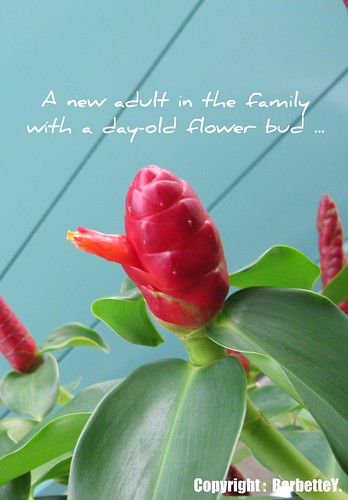
2 flower buds were featured in an enlarged photograph of the GINGER "bulb" (not sure what to call it but it resembled a deep, dark red corn) as above. Looks yummy to the eyes & to the birdie.

Photograph of a new adult spotting a very fat stem and a huge, thick red "corn" with a day-old flower bud whose nectar had already been sucked dry by an Olive-backed sunbird.


___________________________________________________________________________________
Disclaimer:
Please note that I do not own any of the photographs & videos of the Olive-backed Sunbirds featured here on this thread. As such, please give the credits of the photographs & videos of the birds to the relevant contributors.

I wish to thank Mr Paul Huang of
http://www.naturestops.com for granting his kind permission in allowing me to use his beautiful photographs in this forum. It had certainly made an eye-opening difference to a nature lover like myself!

I would also like to thank the creator/s of
http://swapsungeibuloh.wikispaces.com & smalleyes68 (owner of the You-tube video)for their comprehensive write-ups of the birds of Singapore & the video clip featuring an olive-backed sunbird respectively on the internet.